
Big Stink
Sometimes when my city friends visit the farm, they will wrinkle up their nose and ask what’s that smell? As someone who has lived among factory farms of rural Pennsylvania for over 25 years, I can distinguish between the odors of individual species manure that gets spread on open farmland as a means of dispersal first and commonly as fertilizer. Cow is the least offensive of all followed by chicken. Both are tolerable and quickly dissipate. Turkey and pig manure will make your eyes burn. It takes a stick of incense to mask the worst of it. Unfortunately, biosolids collected from municipal waste treatment facilities and the liquid sludge from massive slaughterhouses has also become fashionable to spread on fields. Those two will make you gag. Offered freely as soil amendments in lieu of costly fertilizers, farmers have found out the hard way those freebies came with a steep cost of being contaminated with an assortment of toxic chemicals, including forever chemicals that render their land inoperative for food production.
Agriculture and civilization are both tasked with the handling and disposal of biological wastes. It’s not something most people talk about in polite company, but between farmers it’s casual conversation. There are multiple styles of handling manure ranging from massive holding tanks requiring extremely expensive equipment for use to elaborate rotational grid systems, so the livestock do most of the work. Manure is something we work with on a daily basis, both farmers who raise livestock and crop farmers.
Last Sunday the hot topic among vendors and customers was that smell. Fortunately, my approach to market does not include the Clara Barton Parkway but if it did, I am certain I would easily identify the odor everyone else was smelling. Raw sewage always trumps agricultural manure in terms of foulness. It’s very distinct out here in the country if we catch a whiff of that particular odor, we know it’s time to call the pump truck to empty the septic tank as rural residence are responsible for their own sewage disposal. However, folks who live in municipalities have the luxury of flushing and forgetting. The disappearance of waste and water simply goes down the drain and each year you write a check to the local agency who operates and maintains the infrastructure. Humans have successfully been operating public sewage systems for 6000 years through archeological evidence in Mesopotamia, the Indus Valley and even Scotland with elaborate stone/brick drainage systems.
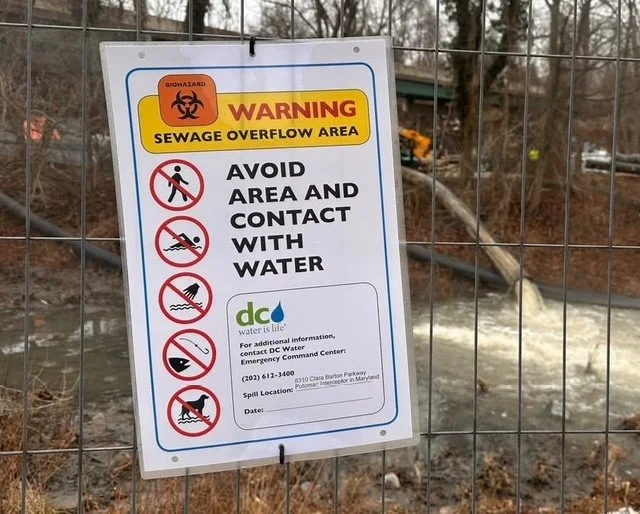
If you don’t already know, there is a massive sewage spill currently taking place in Montgomery County. Over 300 million gallons to date after the Potomac Interceptor, a 60-year-old 72-inch sewer line collapsed on January 19th has leaked into the Potomac River. Why is this a problem? Because over 6 million people in a four-state region drawl their drinking water from the Potomac River. While the Corps of Army Engineers and other entities deem the water supply safe, let’s take a closer look at how this environmental disaster impacts all of us.
The Potomac River is a regional playground. We paddle, fish, hike, and swim in the waters that originate in the Appalachian Mountains of West Virginia and flow 400 miles to the Chesapeake Bay. Additionally, farms depend on the Potomac for irrigation and water for livestock.
Oh, but it’s only a drop in the bucket in the grand scheme of things we’re assured. All will be well in time for summer. Every time an elected official or agency hack says this, I want to pull out my hair and scream No! No! No! What about right now? They do understand a sewage spill isn’t a clean flush after a few rainstorms, don’t they? What about the capillary action of soils storing moisture like a sponge? That moisture is full of bacteria, viruses, and molecules of everything else we dump down the sewer lines. What about all the organisms that live, feed, and reproduce in the river? Sanitation departments have monitored pathogens and drug use through public effluent for decades. Some of the diseases the CDC routinely tracks are COVID 19, Influenza, RSV, Monkey Pox, Measles, and H5 bird flu using data from 1,360 different wastewater treatment plants throughout the country. Did anyone catch the story about Nantucket’s cocaine levels in wastewater being three times the national average? Big Brother indeed.
As a farmer I understand the implications of pathogens (and parasites) in fresh manure. There’s been a growing movement among sustainable/regenerative agrarians to ensure their nutrient use stays on the farm instead of flowing downstream. Manure gets composted prior to being applied to croplands. Heat generated by composting kills off pathogens and parasites. Animals are fenced out of waterways. Riparian buffers are planted with trees and bushes that help filter sediments and even toxins from the water. Crop farmers who fertilize with manure are discerning about the origins. I know Certified Organic growers who are specific right down to the age group of Certified Organic cows—unbred heifers only—from where their manure is sourced. It’s all biology and chemistry. Those outbreaks of O157:H7 E. coli outbreaks in produce don’t randomly happen. The source is usually traced back to manure from cows shedding the bacteria which is prevalent in grain-fed feedlot cattle.
Livestock farmers are required to have manure management plans for our regional conservation districts and municipalities who monitor the health of local waterways. Unfortunately, most zoning and environmental protections have little to no recompense to anyone affected when the regulations aren’t followed. In addition to our crumbling sanitation infrastructure, we keep building chicken houses, hog barns, dairies, and feedlots next to sensitive waterways and wonder why the Chesapeake Bay continues to decline. This is the only home we have, folks. Let’s make it a priority. If we don’t have clean water, our ability to produce clean food will be diminished. It affects all of us.