
Drought or Not?
Water—it’s something most people take for granted, unless you’re a farmer. When you turn on the tap and nothing comes out, it’s an inconvenience and a call to a plumber or your water company. But when your livelihood depends on a steady flow, it’s all hands-on deck until whatever is broken is fixed. Sometimes it’s as simple as digging up the wet spot and putting a sleeve in a pipe fastened with a few hose clamps. Or it can mean pulling a pump out of a 500-foot well for replacement. And if you’re fortunate, you have a good plumbing and well crew on speed dial who will show up within hours of sending out and SOS.
But there are a growing number of places around the world where wells are going dry from long term drought and depleted aquifers, India and the United States top the list for countries overexploiting their water supplies due to agricultural intensification. Other regions including the Middle East and North Africa are water-stressed to the point of civil unrest. Israel and Lebanon hold the top spots for the most rapid loss for access to clean water supplies.
Overpopulation and agricultural pollution have been fouling global water systems further exacerbating geopolitical issues. But the big elephant in the room ultimately is climate change. We all know that these days those two words can bring down websites, funding, and careers. No where has this become more evident than in our ability to track droughts.
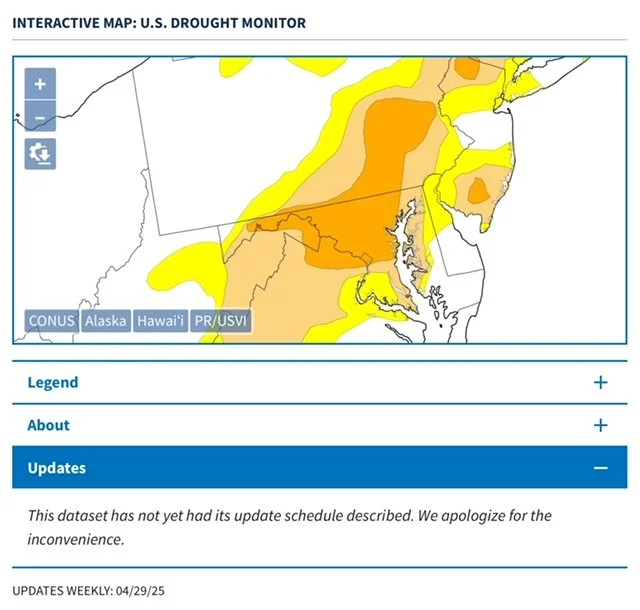
Despite verdant pastures, according to U.S. Drought Monitor our foodshed is classified as D2 (severe). The hayfields might be gaslighting me with their knee-high grasses, but when I had to dig a fairly deep hole even after the rains last week the soil only several inches down was bone dry where it should have been cool and damp. The dryness had me concerned, but I’ve experienced droughts over the years as a farmer and have learned how to mitigate the circumstances--drought-tolerant species, catchment areas, rainwater capture and storage, grazing strategies, soil amendments, to name a few.
One of the most important tools that farmers have access to is data, both current and historical. Unfortunately, we’re losing them. A website that had been updated weekly since it began in 2000 as a collaboration between US Department of Agriculture (USDA), National Oceanic and Atmospheric Administration (NOAA), and National Drought Mitigation Center (NDMC) has not been updated for several weeks. It’s a pretty good chance the funding dried up because someone used those two little words.
But failing to update critical data for the production of food and other agricultural commodities because of politics is bad business. Denying the data doesn’t erase the fact that for a quarter of a century scientists have compared recent precipitation totals to long-term averages, including temperatures, soil moisture, water levels in lakes and streams, snow cover, and meltwater runoff. Using this data, scientists, agronomists, and farmers can identify impending water shortages and economic impacts.
There’s no such thing as a normal drought. They can last from a few weeks to several years as did the one that brought about the Dust Bowl in the 1930s. The American Southwest is currently experiencing a megadrought that began in 2000. I know farmers in California who have ripped out established citrus and avocado orchards to replace them with drought- tolerant and income producing crops like olives and agave. Unwilling to throw in the towel on their agrarian endeavors, they’ve decided to adapt.
But how do we decide to adapt without the data? We are at a place where pronouns (or the lack thereof) are more important than our food security. Farmers have been tracking weather patterns and shifts in the climate for centuries, even before the advent of the Internet. Trees have been chronicling climate, too. They are living databases cataloguing droughts right along with the farmers. They’re a bit more difficult to extract data from, but it can be done. Fortunately, I don’t think DOGE will be turning off the tap to trees’ growth rings anytime soon.