
Extending the Season
As summer winds to a close, the overwhelming bounty of summer vegetables is starting to cross over with the ones of early fall creating twice the amount of available fresh produce normally met at the local farmers market. Peppers and tomatoes are mingling with cauliflower and cabbages. We wish it could all last through the winter.
There are a variety of methods for extending the life of your vegetables. There’s canning, which involves a significant amount of effort and equipment. Those of us with ample freezer space are happy to fill containers and squirrel away for the perfect moment. I like breaking out the first jar of put-up tomatoes when the first snow arrives. There are a few of you out there who even load up dehydrators and freeze dryers, especially the camping and backpacking folks.
But the tried-and-true method for food preservation that has works for millennia is fermentation. Good for more than beer, wine, and sourdough, lacto-fermentation is an anerobic process in which bacteria, fungi, and yeasts break down the sugars to form lactic acid. Yes, not all bacteria are bad. This process creates products such as yogurt, sauerkraut, kimchee, and pickles, but it can be used on a variety of vegetables now plentiful for the next few months.
Not only does lacto-fermentation enhance flavors, it increases the nutritional value. Have you heard the terms gut health, digestive support, or microbiome? If so, this is something you will want to try. It is simple and does not require extra equipment that will languish in your cupboards.
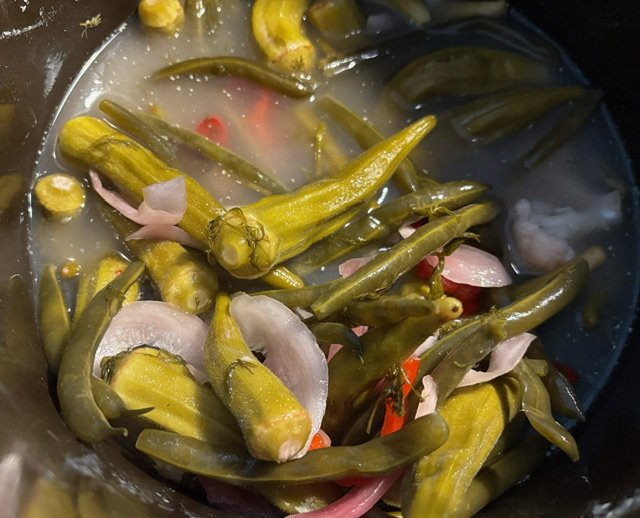
Start out with fresh, clean, raw vegetables. Last week I wanted to ferment dilly green beans and okra. After thoroughly washing them and letting them drain I weighed the total to figure out how much salt to use—2 to 3% of the total weight of the vegetables.
The container used for fermentation can be as simple as a glass jar or one of those fancy fermentation crocks. I used a basic 3-gallon crock, the kind that everyone’s grandmother used to have. She had it for this very reason.
Cut the vegetables to the desired size. At this stage of the process, you can do one of two things—either dry salt, which is tossing the salt with the vegetables to evenly cover them or make a brine using enough water to cover the vegetables in the fermentation container. Salting sets up the environment for moisture to be drawn out of the vegetables and to allow for the growth of beneficial bacteria while inhibiting the harmful kinds. Because the kinds of good microbes you are shooting for do not like oxygen, the vegetables need to be tightly packed and if using a brine solution, need to be fully submerged. This is why I like my big crock. I can put a small plate on top to hold down the vegetables with an old wine jug filled with water for added weight.
Cover the container with cloth to keep out anything that should be in there—dust, bugs, the cats. It can be as simple as a paper towel held in place with a rubber band or even a lid that hasn’t been screwed tight so the gasses produced by the fermentation process can escape. With everything in place, store the container at room temperature.
The fermentation process can take anywhere from a few days to several weeks, depending on the temperature and the vegetables used. During this time, the lactic acid bacteria will convert the sugars in the vegetables into lactic acid, creating a tangy flavor and preserving the vegetables. You’ll want to check the container daily, adding more brine if the vegetables aren’t covered enough, pressing down if dry brining so the liquid covers the vegetable, and skimming the surface for any scum that forms on top.
How to know when they are ready? Taste them! If your veggies have a zing to them, you’re good. Well-fermented vegetables can last for several months without refrigeration, but the fermentation process will continue. I transfer mine to glass jars and store in the fridge.
The possibilities are endless. I’ve made curried cauliflower and brussels sprouts that are as effervescent as Prosecco. Put one of those in a martini!
If you want to try it, but are feeling unsure on the process, there are plenty of great resources that will walk you through. My favorite is Sandor Katz (www.wildfermtation.com). If you’re still not ready to try for yourself, as always, the market has you covered with several vendors who have done the work for you.