
I have been writing this blog each week for several years and I take many of my subject matter ideas from comments made by both vendors and patrons at the markets. There can be no mistaking the hot topic last week, the outcome of a local election that will impact some of our vendors and some of our food choices, especially when going out to eat in a restaurant.
I am talking about Initiative 86 on this year ‘s ballot that was approved by 73% of the voters. Casually, I polled several of my District resident voters and ask them what they thought about it. Bunk! What a waste of energy and money! And my personal favorite, How dare they continue to legislate what we can and cannot eat!
I am talking about the ban that prohibits, force-feeding birds, particularly ducks, and geese, to enlarge their livers for foie gras, a known delicacy for over 2500 years dating back to the Egyptians. The Nile River. The fertile crescent. Any of this starting to ring a bell? In most textbooks, it’s referred to as the cradle of agriculture. This was where flax and cotton were cultivated for fine textiles. Emmer wheat and barley for baking and brewing beer and wine grapes complemented a variety of greens, pulses, fruits, and vegetables that would not look much different than what one would find at a farmers market today. They even kept bees. And from numerous tablets, texts, and art, we know that the Egyptians were raising ducks specifically for foie gras.
While voters will only read the propaganda against the practice known as gavage, very few will understand that the condition of a fatty liver occurs naturally in the wild, and that the practice of filling a bird’s crop with grain is another form of production agriculture. The farmer is essentially taking advantage of a natural propensity in certain species of animals. This is what agriculture is and how we as a species have become so prolific due to our ability to raise calorie rich foods at scale.
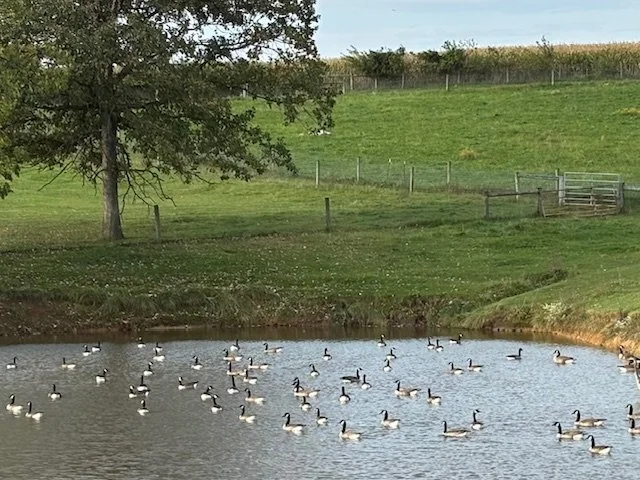
Right now, my neighbors are harvesting their dent corn from the dried stalks using large machinery aptly named a harvester. Not every single kernel of corn makes it into the hopper. Quite a bit ends up on the ground and every day, huge flocks of geese and ducks glean through the fields to gorge on grains prior to their migration south for the winter. Where do you think all the excess calories get stored for maximum efficiency? I’ll give you a hint: foie gras. I would bet that in ancient Egypt hunters realized the best time to harvest migratory geese and ducks was after they had gorged themselves on the grains filling the Nile Delta. From there, it was only a matter of time, figuring out how to mimic mother nature for domestic birds. Gavage, the practice of filling waterfowl gullets with grain using a tube is what they came up with and how commercial foie gras has been produced for thousands of years. The French have become the masters at this practice as the name implies in its origin. There are few American farms dedicated to this type of production, and the ones still in business have been around for generations. Plus, the liver is only one part of their product which also includes the meat from the duck itself, and sometimes the feathers. Razor thin margins in food production means that every single possible dollar must be taken into account if the business is to be sustainable.
All of this from an Internet content creator with a pet duck who partied down the U St. corridor, peddling their brand of animal rights. Never mind all the massive industrial agriculture operations that gobble up all the subsidies the USDA can toss at them (which also happens to be our tax dollars). Or how about the lawless polluting of our waterways with massive manure runoffs along with millions of gallons of chemicals, sprayed on surrounding fields, have drained out into the Gulf of Mexico, causing a massive hypoxic zone where nothing can live and grow. My biggest worry and perhaps the most dangerous issue of our time that we continue to gloss over for the ongoing availability of inexpensive meat—antibiotic resistance. Don’t get me started on the viruses increasingly tearing through our food supply choices. No, we’re going to focus our political energies on a pet duck that will do little more than raise the price on an extremely minuscule part of the food industry and remove beloved items from restaurant menus.
I’ve heard the argument repeatedly about how cruel this practice is and that it must be stopped, but what’s next? Plunging lobsters into boiling water? Or how about eating raw oysters? You’re basically swallowing a live animal, and no one is complaining about that. But then again crustaceans and shellfish aren’t as cute without fur, feathers, fins, and faces.
Until the popularity of a pet duck, how many of the district voters who approved this initiative even knew what foie gras was, let alone had eaten it? It isn’t something you are going to find in a fast casual restaurant, maybe as an appetizer in an upscale bar and only on the menus of finer establishments. At the farmers market, you are most likely to find it as an ingredient in prepared foods.
The food and beverage industry has enough challenges without the cholesterol police, threatening steep fines for selling fatty livers. Fortunately, the ban does not apply to Maryland so we can still enjoy our pates and ravioli.