
Folklore Forecasting
It has rained six out of the last seven weeks noted one vendor as we stood in the pouring rain on Sunday. Patrons asked cautiously what I thought the weather would be like this winter. What does the Farmers Almanac say?
“Snow, sleet, and surprises,” so in other words, a usual winter.
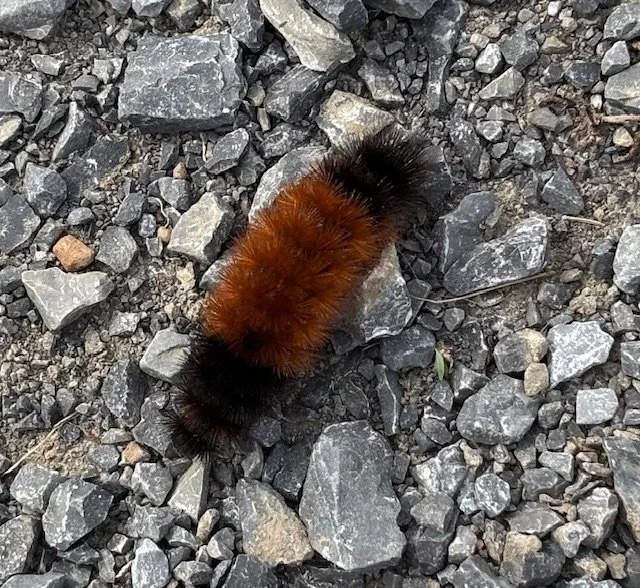
In my neighborhood, the appearance of a wooly bear caterpillar is cause for everyone to stop an examine the colorful bands of brown and black on its body and then try to remember what the significance of the observed pattern means. After all, we listen to a groundhog to tell us if spring is going to be early, why not depend on the larvae of Pyrrharctia isabella, aka: tiger moth, to prognosticate the severity of the impending winter.
According to legend, if the brown band on the caterpillar is wide, there will be a mild winter, but if the brown band is narrow, winter will be more severe than usual. However, scientists have observed variations in band size among the same brood of eggs and the caterpillar’s brown band widens with age as it molts. Not exactly a reliable method for weather prediction, I would say. Yet there are several woolly bear festivals throughout the country for winter weather prediction aficionados and tourist opportunities.
Another popular prediction for impending winter weather is the increased production of acorns, referred to as mast years. Acorn masts happen every 2 to 5 years, but not with any sort of regularity. The overproduction of acorns in a single year increases the chances that some will germinate. There is an entire cycle of acorn mast versus an increase in tick borne illnesses, too, as the increase in food sources provides enough sustenance to maintain a larger host and vector population. I would rather have an extra blizzard than Lyme disease, or worse, Alpha-gal syndrome, which has risen over 9,800% in the United States over the last 10 years.
I went hiking in my local state park last week to take in the Autumn colors and on some portions of the trail there were so many acorns that it was like walking on marbles. I was grateful for my hiking poles. So, I would say this is a mast year for acorns.
The super El Niño has officially been declared by the weather centers, but what that actually means for us in the mid Atlantic region can only be described as a less predictable mix. Although this particular weather pattern usually means milder winters, during the last super El Niño during the winter of 1996-97, the northeast experienced a devastating ice storm.
Living here in the northeast means accepting that from November through April, it is possible to have snow and freezing temperatures. At any given time, the weather can suck. On occasion, it can be downright miserable and bring life as we know it to a grinding halt for several days.
I encounter multiple wooly bear caterpillars on my walk to the barn daily; however, it is the residents at the barn who give me my best indication as to the weather forecast for the season. I am going to have to agree with the prediction for a milder winter as multiple species have yet to fuzz up with their winter coats. There are some years they are in full winter fluff and fleece by September, but as of now everyone is still fairly slick.
I am taking this as a good omen for a mild winter.