
Smoky Times
There are times when having alerts enabled on all the weather apps becomes irritating. Yes, I like knowing when storms are coming, when temperatures will exceed my preset thresholds, when there are lightning strikes less than 10 miles away. But I was tempted to turn them off when the incessant beeping kept telling me to stay indoors due to terrible air quality caused by the Canadian wildfire smoke drifting over the eastern seaboard and shrouding everything in a thick cloud of particulate matter. You know who didn’t have the luxury of staying inside? Your farmers. We can mitigate a lot of environmental factors such as cold weather, scorching heat, and rain, but working early in the morning or wearing the proper clothing is not going to make us any less uncomfortable when it comes to smoke. If we are not outside in our fields and pastures doing the work, you do not eat. It is that simple.
People tend to think of smoke as an ephemeral manifestation, but it is actually made up of tiny particles, in addition to gases that create hazardous air pollutants. The composition is based upon what is burning. Wildfire smoke particulate matter consists of both liquid and solid particles suspended in the air. Because these particles are so small— 2 to 10 µm in diameter—they can be easily inhaled and even pass directly into the bloodstream. When fires begin engulfing man-made structures, toxicity increases significantly. That’s not to say that plain old wildfire smoke is safe as it contains formaldehyde, benzene, ozone, and carbon monoxide, which are all toxic. Even worse is the chemical oxidation that creates free radicals as the smoke lingers in the atmosphere.
Sure, farmers can wear masks or wet bandannas over there faces, but keep in mind the atmospheric conditions causing the wildfire smoke to hang in the air is a heat dome driving temperatures well over 100°. Breathing through a wet rag in oppressive heat while performing repetitive manual labor is no picnic. What bothered me the most wasn’t inhaling the smoke, but what the particulate matter did to my eyes. After each session of farm chores, my eyes felt like sand had blown into them and they stung. In addition to the usual dropping my filthy farm clothes and dirty boots in the mudroom and hand washing, my daily routine also included hitting the eyewash cup and neti pot multiple times a day.
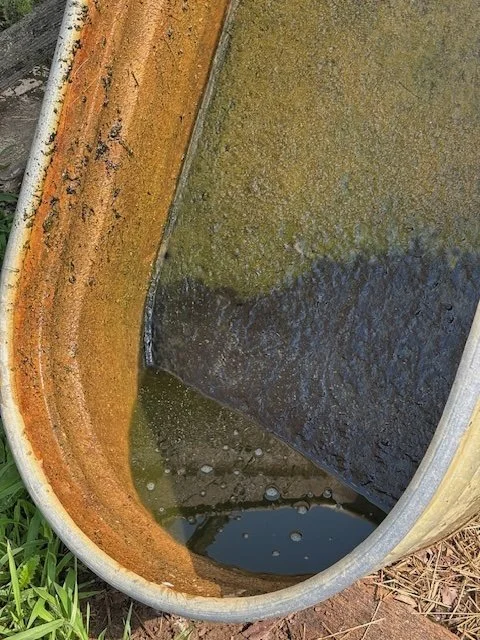
But what goes up must also come down. Not only has the wildfire smoke caused discomfort it has caused more work. This week began with cleaning out all of the animals’ stock tanks. A black film collected on the edges and bottoms. How would you like to drink water out of something that ashes had been dumped into? The lighter colored livestock all looked as if they had 5 o’clock shadows after grazing.
If you think that by staying indoors and running a HEPA filter will eliminate the impact from the Canadian wildfires on your life, I’ve got news for you. These increasing fires are going to have a very direct impact on our food system. Cows don’t milk as much, poultry (both pastured and industrial) die, ruminants don’t want to eat as much because their pastures are less palatable being covered in a bitter grit. Oh, but your vegetables are grown in a greenhouse? Those greenhouses are not hermetically sealed, and air conditioned, they depend on ventilation from the outside world. Most importantly, the wildfire smoke blocks sunlight, which is necessary for plant growth. Other issues caused by excessive smoke is the effect on pollinators. There is a reason beekeepers use smokers when working their bees. Smoke taint is a significant issue in fruits, especially grapes. Who wants their wine to taste like their barbecue?
As both farmers market farmers and eaters attempt to circumvent the challenges of the industrialization and commoditization of our food system, there is little we can do over global issues, such as the Canadian wildfires. The ignorance surrounding the circumstances of the increasingly very large fires that have gained momentum over the last few decades is staggering. American elected officials want to lay blame, but we should all look in the mirror. Drier and more volatile climate conditions have led to an increasing amount of wildfire fuel in remote, boreal forests that make fighting such fires impossible. Currently there are over 900 active wildfires in remote and heavily wooded regions of British Columbia and Ontario. There are no roads for fire trucks. Water bombing planes cannot make a difference. Officials simply monitor them to make sure they do not threaten populated areas. Most are caused by lightning strikes.
My blue skies have returned, but the sad truth is wildfire smoke never truly disappears. It gets carried into upper level winds and jet streams, covering vast distances before being deposited back to the ground through rain and snow. It settles onto the land and in the water becoming a permanent part of the geological record.