
Spring Dinosaurs
One of my great enjoyments of being a vendor at the farmers market is watching the kids. They are the true bellwethers of fashion, not the young 20 somethings in their budding sense of style with Japanese street clothes and pop star emulation or the next generation in their logo-centric designers or even the following generation who can finally afford to wear real couture labels. But then again, this is being written by someone who lives in utilitarian coveralls and work boots 95% of their life. What do I know about fashion?
But I do know about nature, biology, and dinosaurs. One of the more popular styles among the under 10 set is the Jurassic. Especially on rainy days, there are multiple mini stegosauruses running around with scutes from their jacket hood to the hem. Some even have little tails that run nearly to the ground, too. My favorite is the colorful bike helmets with faux bony plates. Those bland, grayish, brown depictions of dinosaurs never felt right to me. I always imagined them like colorful, iguanas or geckos. And the ones that had feathers were probably just as brilliantly colored as my chickens. But given my experience here on the farm, Mother Nature occasionally proves me wrong on this belief.
Why?
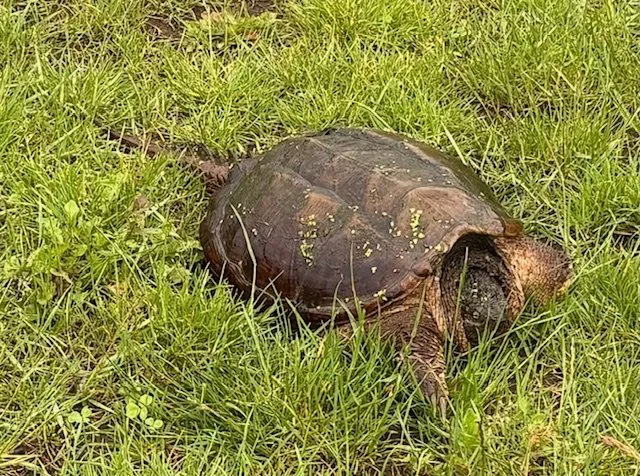
Because I have real live dinosaurs living on the farm and they are a bland greenish brown that blends in with the landscape. Meet Chelydra serpentina, aka: the snapping turtle or as I call her, Big Mama. Yes, this is definitely a female because this is the time of year when they make their track from the run up over the hill through the woodlands, across the hayfield and down to the pond where they lay their eggs before heading back from where they came. In this species, females are far larger than their mates.
Long before there was a Roomba, there were snapping turtles. They are masters at going around barriers they encounter in order to get to their preferred nesting destination. From the telltale tracks left by a 40-pound reptile dragging itself along on its plastron using sharp, long toenails, I saw that she utilized the same divots under the fence and gate that the Great Pyrenees uses to move between inside and outside the permanent fencing. Earlier in the week I had witnessed an encounter between the two species. The dog, which outweighed the turtle by more than twice, knew he was outmatched by his opponent and wisely went on his way. I should have filed the presence of a snapping turtle in the front of my mind instead of the back when I went out to weed whack along the fence line. With all this rain, keeping up with the growing vegetation using only the livestock as mowing devices was no longer working and required human intervention with power tools.
Weed whacking is one of those mindless chores that is made even more mindless by the necessity for ear protection. Add in safety goggles over sunglasses and you end up in your own little bubble ambling along fence line and around the trees until the fuel runs out. But experience has taught me that a certain amount of vigilance is necessary. Throughout the years of weed whacking, I have encountered bumblebee nests, baby bunnies, groundhogs, and snakes. Now I can add a snapping turtle to the list. Let me tell you, I screamed like a little girl as soon as the nylon blades exposed a carapace and a neck shot out with a gaping mouth open and hissing. Yes, turtles hiss. A blood curdling squawk echoed across the pastures. Everyone stopped grazing and stared at me for what was to come next. After backing up to a safer distance and turning off my equipment, I checked my phone to assuage my neighbors' fears that I was not OK had they heard the scream and then I took a snap of the turtle to show them the monster.
A few hours later I would find that same turtle in the front yard of my house nearly a football field’s length away from where I had exposed her with the weed whacker. She was on her way back down over the hill to the run, having deposited her eggs in the soft dirt by the pond.
When I was growing up my dad trapped turtles for sport. He would fish for them at private ponds where people did not want the snapping turtles eating their fish, frogs, and ducklings. They also didn't want an animal in their pond where they swam that had a biting force with over a thousand pounds per square inch. For comparison, a dog tops out at around 350 PSI. Dad used a contraption that consisted of a stainless-steel leader with a big, barbed hook baited with a chicken neck attached to an empty one-gallon jug. By the time I hit junior high school I had seen so many turtles prepped for soup that the frog dissection was no big deal.
This farm’s pond is not one to swim in as it contains decades of detritus that has resulted in a thick layer of stinky anaerobic mud. Years ago, I made the mistake of trying to clean out a blocked overflow standpipe using a pair of chest waders and became so mired in the muck that I had to wiggle my way out of the boots and wallow to the waters edge. But this is a perfect environment for turtles.
Despite having been around for over 220 million years, most of the turtles found in the northeast are in decline. Over the years, I have identified several species here on the farm, an indicator of a healthy ecosystem. When there are aquatic turtles laying their eggs by the pond, that means there is food for the herons who nest in the run.
As much as I would love to show the kids at market the dinosaurs that lives on the farm, a picture will have to suffice. And a note to adults, if you encounter one of these trying to cross the road or anywhere else, DO NOT attempt to pick it up. As much as we all want turtles to get across the road safely during their spring egg laying season, this one will hurt you. And if you pick it up by its tail in an effort to move it safely, you will hurt the turtle.