
Upside Down
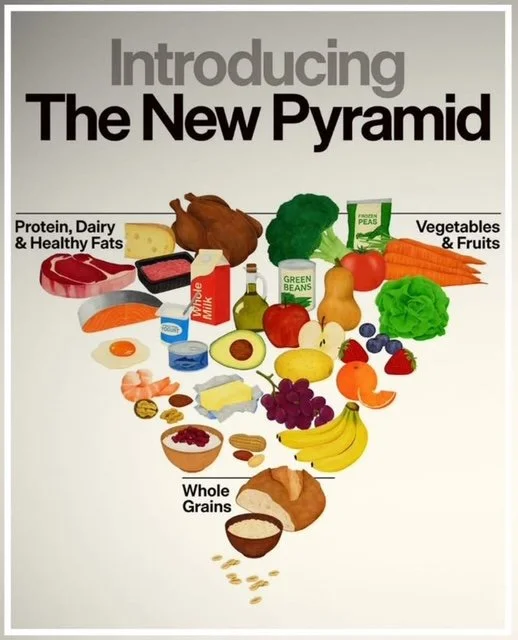
You don’t think I’d let this administration’s Department of Health & Human Services and the USDA flip the food pyramid on its head and then not comment on it? While our government likes to take credit for the idea of food pyramid nutrition, it was actually the Swedes who first introduced nutritional food groups back in the early 1970s. It was adopted by other Scandinavian countries along with Germany, Japan, and Sri Lanka. Twenty years later the United States invented the food pyramid to represent the number of servings from each food group one should eat each day for a balanced diet.
It should be noted that the original nutritional pyramid was created due to high food prices. The purpose was to explain how food groups of inexpensive yet nutritious foods at the base could be supplemented with more costly foods at the top to provide a nutritionally complete diet. The joint WHO/FAO project simplified the early system even further by dividing food groups into protein, fat, unrefined carbohydrate, and free sugars.
But the average eater wanted little pictures of fruits and vegetables, not percentages of proteins, pulses, and polyunsaturated fatty acids. Where were the tacos, frozen yogurt, and diet sodas on the chart?
The Basic Seven was first introduced by the USDA back in 1946 telling Americans to eat any other foods you want in addition to the Basic Seven which were 1-leafy green and yellow vegetables (one serving), 2-citrus fruit, tomatoes, and raw cabbage (1 serving), 3-potatoes and other vegetables & fruits (2 servings), 4-milk, cheese, and ice cream (2 cups for adults and a whopping 3-4 cups of milk for children!), 5-meat, poultry, fish, eggs, dried peas, beans (2 servings), 6-bread, flour, cereals, whole grains (every day, whatever that meant), and 7-butter and fortified margarine (some daily, no definition of some). Added to the recommended diet was the admonishment, don’t waste food.
Oh the irony! Not only have we flipped our dietary guidelines, but we also waste approximately 40% of our food supply each year, throwing out 120-133 billion pounds of edible food each year which translates to around 325 pounds per person.
In my lifetime I’ve watched a number of nutritional flipflops from the experts. There were the artificial sweeteners that were pushed to help keep us thin until scientists revealed they caused insulin resistance, affected gut health, and were possibly carcinogenic. When I was a child, no one ate butter. We all ate yellow spreads out of tub which we know now as unhealthy trans fats and hydrogenated oils scientifically linked to heart disease. Bacon and eggs were bad, then they were good, then bad again, and now back to good. Evil fat was skimmed off of our milk, although what was left was basically sugar water. Meanwhile processors reaped the profits from the cream which was turned into value-added products such as ice cream and butter. There wasn’t a peep about what homogenization did to the nutritional value of milk and today most folks still don’t understand the digestion of whole milk fats versus that of homogenized molecules. And don’t even get me started on the whole raw vs. pasteurized issue. Having milked cows let me tell you how quickly you can muck up sanitation and get sick if you aren’t paying attention. Consider raw milk on par with cannabis, abortion, and concealed carry—in some states it is legal and in others it isn’t.
The sad reality is that the majority of our food choices and dietary suggestions are a result of industry lobbying—not scientific research and facts. I like that the message at the top of this new food pyramid is to eat real food. The problem is there’s a lot of real food out there which is produced in environmentally and socially irresponsible ways. Producing real food is hard work and often not wildly profitable. Additionally, 85% of our food system is dependent on immigrant labor. Maybe ICE and HHS should be discussing how our new immigration policies aren’t supportive of the updated food dietary guidelines.
Take a look at the USDA’s agricultural programs and you’ll see the majority of funds are awarded to industrial conventional agriculture, often as a subsidy to reduce environmental damage. They’ll provide a low interest loan to someone building a million-dollar contract chicken or hog barn but not lend to farmers to independent farmers growing food to sell within their community.
The overhaul of our nation’s nutritional guidelines came out of the statistics that 90% of healthcare costs are spent on preventable chronic diseases linked to diet and lifestyle. Secretary of Agriculture Brooke Rollins said, “Farmers and ranchers are at the forefront of the solution,” but that simple sound bite isn’t so simple. There are plenty of farmers and ranchers out there who aren’t interested in the health of the environment and the soil, let alone their customers. Don’t believe me? Look at the massive nutrient and chemical runoff in the Mississippi delta that has caused a hypoxic dead zone in the Gulf of Mexico that averages over 5,000 square miles each year. That’s about the size of New Jersy.
Looking at the new food chart I couldn’t help noticing that practically all the foods listed (except for bananas and avocados) can be purchased at one time or another throughout the year at our farmers markets. I won’t go as far as to say everything at the market is healthy as there are plenty of opportunities for dietary sinning, but then again they’re quality sins.
Speaking of which, HHS and USDA also made another change to the new dietary guidelines—they removed specified limits to alcohol consumption. Hey, that’s all farming, too, isn’t it? It was a face-palm moment to hear Dr. Oz casually advising to “consume less alcohol for better overall health”, but with all the upheaval these days I don’t think that’s going to happen. At least we’ve got good booze at the market, too.