
Bean Time
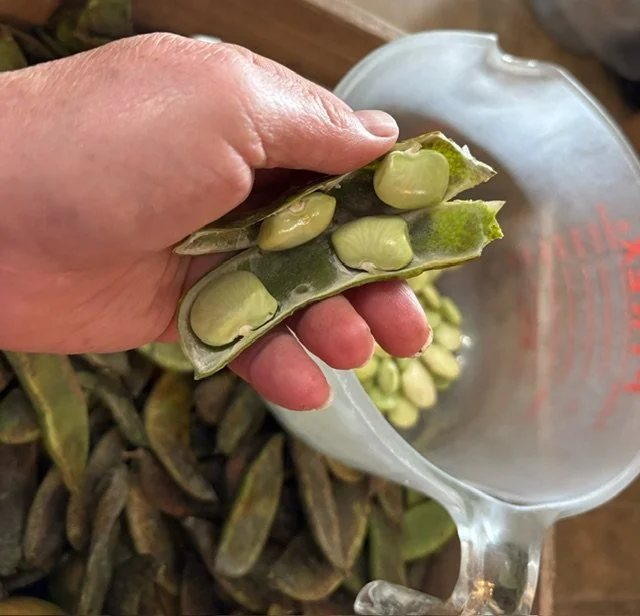
As I packed up for market last week, one of the stragglers who show up five minutes after the market closes poked their nose into a crate I was loading into my vehicle and asked, “What are those?”
“Lima beans,” I replied.
“Oh, no, no, no. Those aren’t lima beans. I know what lima beans are and that’s not what they look like,” they responded with all the authority of someone who had farmed for many generations.
If it’s one thing that really ruffles my feathers it’s when people don’t stay in their own lane when it comes to agriculture. I don’t tell you how to do your job and you don’t tell me how to do mine. Given our proximity to NIH and DC, we’ve got plenty of patrons with both MD & PhD after their names. Over the years I’ve learned a lot from these folks. At times I’ve even altered my agricultural practices based on the scientific research and findings they’ve shared with me. But it took everything I had not to f-bomb this one’s ignorance into next week, opting instead to snap open one of the beans and show them how lima beans actually grow while channeling my best Samuel L. Jackson stare.
It's a common question among market goers why there aren’t fresh legumes like peas and such. Customers asked for soybeans, pointing out the size of the once massively exported crop not realizing there’s a H U G E difference between the soybeans shipped to China and of that one finds steamed with a little salt and served at your favorite Japanese joint. And the vegans think all that soy gets turned into tofu when in fact, the majority is turned into soybean meal used in livestock and aquaculture industries.
Chickpeas are another legume people believe should be locally produced, given how popular hummus is. But garbanzo beans are persnickety when it comes to temperature and dryness. They can only be grown in the drier regions of the country such as the northern plains.
While we have a peanut butter vendor, you’re not going to find any local peanuts on a commercial level, either. They’re native to the south with lots of heat and humidity.
While I was fortunate enough to score the leftover limas on Sunday, what my interloper and most consumers fail to understand is the amount of work and equipment necessary to obtain cleaned legumes ready to cook. My stash yielded eight cups after two hours of shelling by hand.
Years ago there was a neighboring farm who had a homemade pea-sheller that was a cross between a hopper for bingo balls and a washing machine. The intact pods would go in and get tumbled open. The water spray would help wash the peas out of their shells and through the grated hopper into a catch pan below. They charged ten cents a pound for this service, but it was more like a social pilgrimage that took place each year after the family garden harvest. Their device worked only on peas. There would have been no way the lima beans I shelled by hand would have ever made it through the cage.
Shelling beans is a social event. It usually involves multiple generations of family and neighbors. More recently, it may be a group of homesteaders or localvores, but very few people are going to buy a bushel or two of whole beans that require manual shelling these days. They’re more a novelty, a one-meal wonder as opposed to canning by the quart as my grandmother did. She and Pappy preferred butter beans which are of the same species, but only more mature and beige in color as opposed to the green younger beans.
On a large-scale crop, however, beans are harvested using a combine after their stalks have been cut and the entire plant arranged in windrows to dry, much like the way hay is made. Instead of a baler scooping up the hay into a large, tight bale, the combine gathers up the dried plants on the front end where they are sent through a series of beaters and shakers [aka: threshing] and cleaned using fans to remove debris.
If you’re buying dried beans—navy, kidney, pinto, cassoulet, black—or any dried legume like peas, chances are the equipment used to harvest them ran well into the six and seven-figure range meaning the farmer needs to grow enough to justify the expense of the harvesting equipment.
If you find beans needing shelled, pull up a chair and queue up some music, a good audiobook or podcasts. Or better yet, buy double what you planned on and invite someone over to sit a spell, shell beans, and visit. Send them home with half. The world needs more people shelling beans right now.