Chili Season
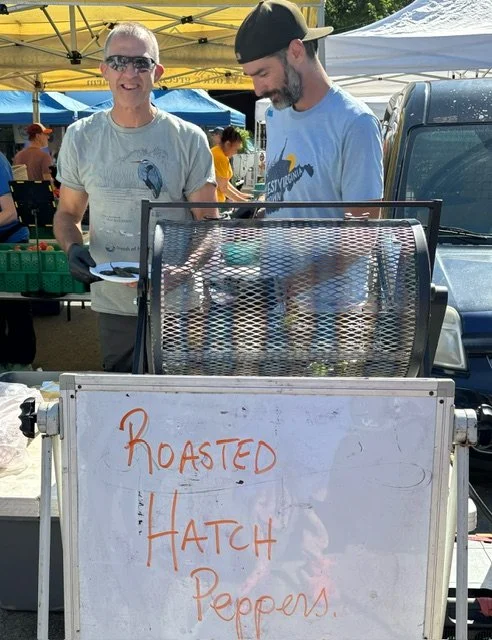
As a farmer I would have to say one of the most underrated senses is that of smell. Farmers depend upon their olfactory nerve to alert them to multiple situations, many with the potential for disastrous outcomes. I am highly tuned to something burning. It could be a damp bale of hay ready to combust and take out a year's harvest. It happens. The barn is over 200 years old. A whiff of something burning always catches my attention. At market I’m accustomed to the wood-fired pizza vendor torching off their oven, but last Sunday my nose detected something foreign burning and it was close by. It took a few minutes until I spied the contraption that looked like a bingo number barrel attached to a propane bottle. As the aroma grew, there was no stopping the Pavlovian response to blistered chili peppers. My lizard brain stem lit up like the Eiffel Tower.
Welcome to Hatch chili season.
Hatch chilies are a kin to saying Kobe beef, a product gaining its name from the specific geography in which it is grown, this case being the Hatch Valley in New Mexico which is a high elevation volcanic soil creating a distinctive terroir. That’s not to say that Hatch chilies cannot be grown anywhere else. Sometimes they are known as Anaheim chilies or green chilies or even Pueblo chilies, but whatever you call them their complex flavor includes earthy, sweet and smoky notes are coveted by both home cooks and professional chefs alike.
There is more to chili season than just growing and picking them. The real magic comes from roasting them, especially over an open flame and high heat until the skin blisters, gently steaming the pepper flesh to a soft consistency.
Fresh peppers offer a crisp texture and fruity flavor. After all, peppers are technically a fruit. When kissed by fire until the skin blisters and blackens, the sugars in the flesh caramelize, concentrating the sweetness. An added bonus, roasted peppers once cooked can be covered in olive oil and stored in the refrigerator for months.
This past winter as Rob Young at Young Harvests was cruising through the seed catalogs for the coming season he spied a gadget—a tabletop propane powered Hatch Chili Roaster. The idea of value-added products has been drilled into every market vendor’s brain by conference workshops, USDA grants, and Extension agents. But farmer Rob pointed out the obvious, “It’s something that keeps me interested and lets me do more with what I already have.” He also pointed out that people like to be entertained. At first he wasn’t sure how a giant flaming beast would work out at market, but soon there was a line of customers waiting for their pints and quarts of roasted peppers. “People, especially those who have been to the southwest, were on it,” said Young.
If you’re uncertain about how to use roasted peppers, here are some ideas using other ingredients also found fresh at the market right now.
Salsa—roasted chili peppers give fresh salsa a deeper depth of flavor thanks to the smokiness. Simply chop with fresh tomatoes, onions, and cilantro.
Chili sauce—blend roasted chilis, sautéed onions and garlic, and a cup of broth.
Dip— blend smooth with feta cheese, ricotta, or yogurt.
Add to vegetables—corn, summer squash, eggplant, okra, beans, you name it. A few roasted chilis kicks up the flavors.
Include in corn bread, quiches, casseroles, and stews.
But as good as they are you might find yourself snacking on them and they may not make it home from market. Better pick up more than one container.
Note: chili roasting is only available on Sundays at the Bethesda Central Farm Market.