
Corn Sweat
Humidity. Wet bulb temperature. Feels like. Within minutes of arriving at market we’re all drenched in sweat. Some of us change hats, others change clothes completely before the lines are set loose. We have personal fans, misting fans, coolers filled with waters, drinkable yogurts, electrolyte-laced drinks. A few swear by the fancy bandanas with a built-in cold packet pocket. My personal favorite is a spray bottle filled with cold water.
We could argue politics until we’re red in the face (more likely from the heat) about the cause of the heat and humidity this summer. In six months, I’ll be wondering why the market has been in the 20s for four weeks in a row or was that last winter?
Now what if I told you that modern agricultural practices and the farm bill is raising the temperatures we’re increasingly suffering through?
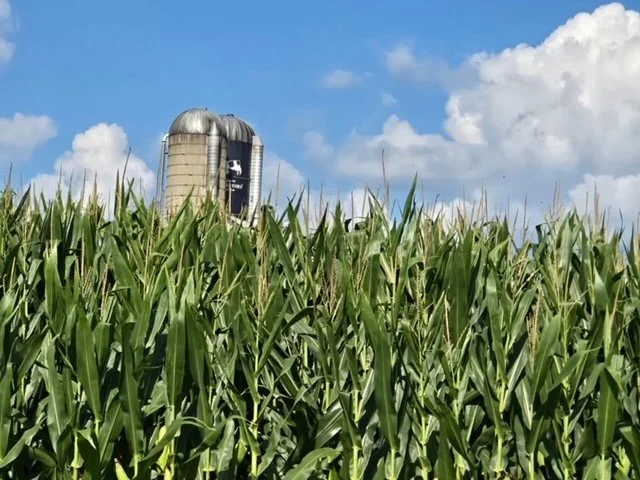
Does your corn sweat? asked an inquiring customer. First, I explained that not all farmers grow corn. My primary crop is grass. It’s pasture and hay fields for the livestock. If I need anything with corn, I purchase it. Corn is a labor and equipment intensive crop. But for the farmers at market who grow corn, along with any other crop farmer, yes, their corn sweats. One customer even tried to tell me that only GMO corn sweats. WRONG!
All plants, including corn, take in water through their root systems and release water vapor through tiny pores in their leaves called stomata. These are like little mouths through which plants exchange gases like oxygen and carbon dioxide. The entire process is known as photosynthesis. The stomata also help to regulate a plant’s temperature and prevent dehydration through a process called evapotranspiration, aka: corn sweat.
Although pundits argue that corn sweat isn’t a significant factor in climate patterns, large areas of corn do have the capacity to increase regional mugginess on hot days. Consider that one acre of corn releases as much as 4,000 gallons of water into the atmosphere per day during the tasseling and flowering stages. I’ve got neighbors who grow 500 acres of corn. That’s 2 million gallons of water each day belched into the atmosphere just in my neighborhood. That would fill three Olympic-sized swimming pools each day.
According to the USDA, farmers planted 95 million acres of corn in 2025, much of it highly subsidized for ethanol production. Although much of the nation’s corn crop is in the Midwest, if you believe all that water vapor in the air stays in the Midwest, you need to go back to tenth grade science class. Still, agronomists argue that humidity is driven more by southernly and westerly winds from the Gulf of Mexico and large-scale atmospheric water flow. But meteorologists disagree, citing that in heavy corn and soybean growing regions evapotranspiration can increase relative humidity by as much as 40%. Yes, soybeans sweat, too.
Not one for blaming the need for air conditioning on my fellow farmers, I’m more concerned about what else large-scale corn and soybean production puts into the atmosphere, like diesel particulates, topsoil, and chemicals. You know those massive tractors used for large-scale crop production measure their fuel consumption in gallons per hour? They’re also not held to the same emission standards as transportation vehicles. And if that carbon footprint isn’t big enough, consider the energy used in the production of herbicides like atrazine and glyphosate, pesticides including chlorpyrifos and imidacloprid, and fertilizers such as ammonium nitrate and urea. Do you have any idea how much energy it takes to make and transport that stuff?
So next time you’re buying corn at the farmers market, remember if you find a worm, that’s a good thing.