
Food vs. Energy
It’s become a weekly question: how is the war going to affect farmers? Patrons don’t like my answers. Some accuse me of paranoia, others call me a doomsdayer, but I’m the farmer and intimately know what my inputs and costs are. Here’s the thing, even if you grow tomatoes and salad greens on your own back porch, energy is involved somewhere along the way.
Did you buy those seeds online out of a fancy printed catalog which were delivered to your home? There was a long supply chain to get your order to your front door. And just where did those seeds come from? Seed production farms are very different that ones that produce food. First, the plants themselves are covered in protective netting to ensure they are not cross-pollinated from other varieties. Those nets? Petroleum-based made in a highly industrialized manufacturing process. Similarly, there are rows and rows of plastic mulch to suppress weeds. Because the goal of seed production is to maximize the yield of disease-free seeds, fungicides and pesticides are often applied. And don’t pull your Certified Organic card on me. There are plenty of approved pest and fungus deterrents, all which require energy to produce. If seeds are the final product that means the fruits and vegetables much go through their entire lifecycle rendering the foods themselves inedible. Those tasty okra pods that will be showing up at the market later this year are the buds for the most incredible flowers before the fertilized blossom morphs into a seed pod containing next year’s crop. Once the seeds are mature they are harvested using specialized equipment (think giant vacuum cleaners), cleaned using either a wet or dry process, tested for germination, and packaged for sale, each step consuming energy. I’m all about seed companies whose catalogs are printed on recycled paper in a single color using plant-based inks. They understand. If you think that the price of energy can’t impact how much farms spend on seeds, ask your favorite farmer what their seed bill was this year. You’ll be shocked.
Fruits? Those are mostly trees and perennials so they shouldn’t be too impacted by the price of Brent crude oil, right? Wrong. Over the last month I’ve watched as the local orchards have been preparing for the upcoming season. They’re out pruning their apple and stone fruit trees for optimal production and removing old and diseased trees. They’re using trucks, specialized tractors, and chainsaws.
While I’m on the subject of fruit trees, I’m just going to toss out the unstable spring temperatures vacillating from the 70’s to the 20’s as a sign that in the future fruit trees won’t be able to sustain their blossom and pollination cycle well enough to establish a crop thanks to climate change caused by our dependency on petroleum, but let’s not stray too far from the subject. With the growing costs of diesel and kerosene, they certainly won’t be going back to using smudge pots.
Now that our seeds are in the ground and growing, there’s going to be more energy used to cultivate, weed, and finally harvest. The biggest jump in price worrying farmers is the cost of fertilizer. Not only has the war in the Middle East stifled the movement of fertilizer being shipped through the Strait of Hormuz, but the skyrocketing price of natural gas will also cause production costs to rise in the future. While small to mid-sized farms often rely on regenerative nitrogen production through the use of legumes and green manures, large scale crop production is dependent upon conventional fertilizers. Think wheat, corn, and soybeans.
Farmers measure fuel consumption of their equipment in gallons per hour. My neighbor’s big tractors they use for haymaking take 8 gallons of diesel per hour. Someone had the audacity to tell me farmers could just do everything by hand. There was a time when we did. It was called slavery.
Once all the crops have matured and been harvested, they need to be packed and stored until they can go to market. You know what takes a lot of energy? Refrigeration. Some farms saw the writing on the wall with energy costs and climate change years ago switching their entire operation over to solar and wind power, a wise move that will insulate them against rapidly increasing electricity costs. Just wait until we have to compete with all those data centers for electricity.
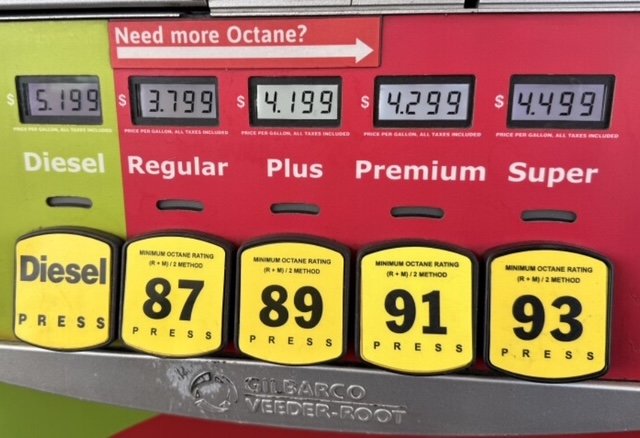
The final miles of your food take even more liquid fuel. Some of us travel close to a hundred miles each way each week for each market, stopping at the pumps either on our way into the city or on the way back to the farm (or both). Each time we stop at the pumps we’re experiencing firsthand the impact of the growing global instability of energy costs. On March 1st I paid less than $2.50 a gallon for fuel. Now it’s $3.69 a gallon. Diesel is $2 more per gallon. All I can think of is ouch! as I watch both market trucks and tractor trailers on the road.
Finally, dear customers, the costs will eventually trickle down to you in an assortment of ways. First, there will be rising food prices. There’s no way farmers can absorb rising costs at every single step in production. I’m already starting to see where vendors are trying to compensate for waning profit margins such as surcharges for using credit cards, driving vehicles with better fuel efficiency, reducing staff, and eliminating less profitable products. I’m hearing from fellow farmers considering getting out of the business altogether because they cannot make enough to break even, let alone profit. How does anyone expect to raise the next generation of farmers if this generation can’t make a living off their land? When we lose farms, we lose more than food production. Often those properties are sold off and developed as non-agricultural entities consuming more energy and reducing food production. I don’t have the answers to solve such massive problems, but each day when I wake up and walk out my door to farm I’m at least trying.