
Spring Singing
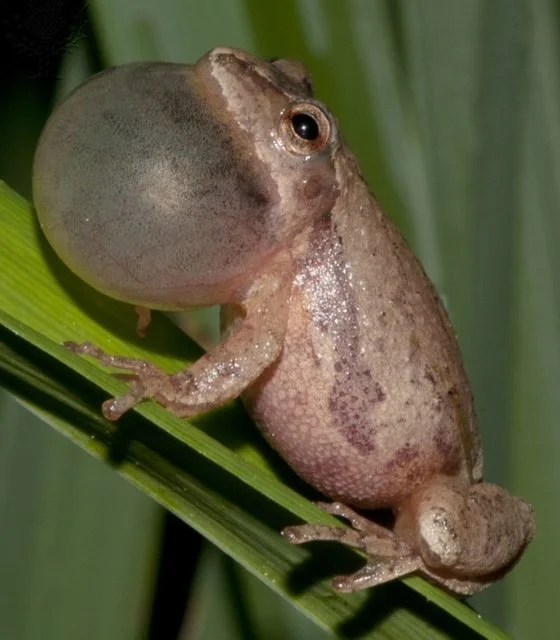
Although most folks consider birdsong a sign of spring, for me it is the sound of spring peepers (Pseudarcris crucifer) which are tiny chorus frogs native to the eastern US. Sunday afternoon when I stepped out of the vehicle after a lovely market day {finally!}, I could hear them singing. It felt like Mother Nature putting her arm around my shoulder and whispering in my ear everything is going to be all right, the worst of it is over. Thankfully! That was some harsh winter.
In the city and suburban areas, municipalities and developers spend a lot of effort to prevent standing water, channeling water drainage to somewhere other than residential and public spaces. You’ve heard the political slogan drain the swamp? Well, that’s exactly what the early inhabitants of the DC region did when the nation’s capital was first built because it was originally wetlands. There was a good reason the governing bodies of early congresses adjourned every summer and left the area. It was called Yellow Fever. This often-deadly disease was caused by mosquitoes spreading at epidemic rates through densely populated areas close to marshlands. People would leave the cities to get away until the first frost killed off the mosquitos making it safe to return. By the way, guess what put an end to Yellow Fever outbreaks—vaccinations in the 1930’s that offered 100% protection with a single dose.
But here on the farm water features and their wildlife that goes with them is a big plus, part of a healthy ecosystem which supports a vast array of wildlife, including an assortment of very vocal amphibians. There are a permanent pond and a year-round stream along with seasonal runoff runs, vernal ponds, and natural springs. Soon these wet spots will host gelatinous masses filled with little dark spots. In a few weeks all those spots will turn into wriggling tiny tadpoles who will sprout tiny legs with which they will crawl out on to the land and begin singing starting the cycle all over once again.
There are more than Spring Peepers singing as the weather warms. The Wood Frog (Lithobates sylvaticus) is another species found throughout North America. What makes this little character so special is its ability to survive winter by literally freezing itself. As the ice forms between the cells in their bodies their hearts quit beating and they stop breathing. The peepers deal with the winters by flushing its bloodstream with a cryoprotectant that acts as an antifreeze.
The chirping increases in frequency and volume as temperatures rise. Some of the male peepers, referred to as satellites don’t sing at all, instead situating themselves near loudly singing males in hopes of intercepting females who chose mates based upon how well they chirp. The chirping sound comes only from the males who have a vocal sac that inflates/deflates like a balloon to make their loud high-pitched call.
These frogs, both males and females, have voracious appetites to muster the energy needed for all that singin’ and lovin’ with a protein-rich diet consisting of beetles, ants, flies, spiders, and other invertebrates filtered from water. Their offspring once they hatch into tadpoles are suspension feeders grazing on organic matter such as algae.
Once the population explosion of frogs is in full swing, I suspect the next to become active will be the wildlife who eats the frogs, including snakes, skunks, birds, and other frogs. Judging from the odor in the morning when I walk down to the barn, the skunks have already heard the peepers and have come out for the buffet.
I look up at my well-worn copy of Rachel Carson’s 1962 landmark book, Silent Spring on my bookshelf that chronicled the impacts of modern chemicals and pesticides on wildlife, especially amphibians, which led to environmental regulations and laws and think about how woefully empty and sad life would be without Spring Peepers.