
Ginger Season
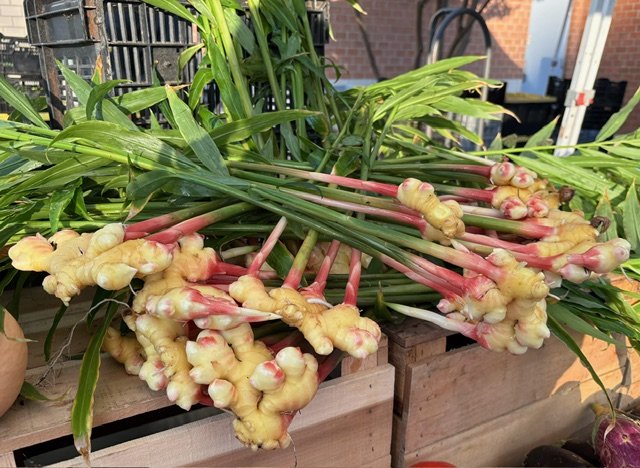
I knew it had to be showing up at market any week now as the jar in my refrigerator was down to one last nub which was looking kind of sad. Sure enough, I smelled it before I saw it as my fellow vendors fanned out a display of fresh ginger with the tall green leaves spiking out from the knobby golden tubers tinged with hot pink. Time to refill my jar.
Ginger is a flavorful and pungent spice that grows from underground stems called rhizomes. For thousands of years, it has been used medicinally as well as food seasoning. It was one of the first spices transported from its native environment of southeast Asia, exported to Europe through the maritime spice trade during the Roman Empire.
Technically, there is no such thing as native ginger as it is a cultigen, meaning it does not exist in a wild state. It has been cultivated from clones and cuttings for so long the original cultivars no longer exist. Ginger grows in a wide variety of geographies, but does best in warm, humid climates with well-drained soils. It is a lovely perennial with yellow flowers and is used extensively in tropical landscaping.
When you encounter ginger as a spice commercially, it’s either dried and ground, only the rhizome, or pickled like the kind served at a Japanese restaurant with sushi and sashimi. You’ll find crushed pickled ginger at specialty grocers, too, but the oh-so-fresh stuff sold at the farmers market often comes with the stalk which is really just tightly rolled leaves. The leaves are equally useful for teas, salads, and curries when both fresh and dried. One of my favorite things to do with fresh ginger leaves is cook fish with them, the same way I use fennel fronds for imparting a delicate flavor.
The ginger root itself has a range of shelf life depending on how it’s preserved. Nothing beats freshly sliced or minced ginger in whatever you cook. Tossing it with buttered carrots with a touch of honey is one of the first things I cook when I bring home the first batch of fresh ginger. Another favorite is simply pouring boiling water over a tablespoon or so of freshly minced ginger and making tea. One of these days I am going to try making ginger beer and ginger candy.
Ginger has been a medicinal for millennia documented in Chinese medicine going back 5,000 years. Today modern medicine continues to promote the consumption of ginger for aiding digestion, fighting inflammation, lowering blood sugar and blood pressure, and as a sleep aid. It is effective enough to call for warnings to people who are diabetic or taking blood thinning medications.
The ginger root found at grocery stores is cured, meaning a tough outer skin has darkened and dried to preserve the fibrous insides. But fresh ginger has a thin skin that can be scrubbed clean and eaten although most people still peel the outer skin. Fresh ginger can be pickled with rice vinegar, sugar and salt which will keep well in the refrigerator. My method is more unconventional, but over the years I’ve found it works well and yields a bonus used in baking. After the fresh roots have been thoroughly washed and dried I put them in a glass jar and add an ounce of Everclear, also called grain alcohol. It’s high alcohol content–190 proof which is 95% alcohol—will prevent molds from growing and thus the roots from rotting while refrigerated. Mine last for about a year in this concoction as long as I give the jar a good shake regularly. For desserts and baking I’ll swipe a teaspoon of the liquid to impart a hint of ginger.
This delightful specialty item is available only at this time of year at your local markets so snap it up when you see it.