
Moon Shot
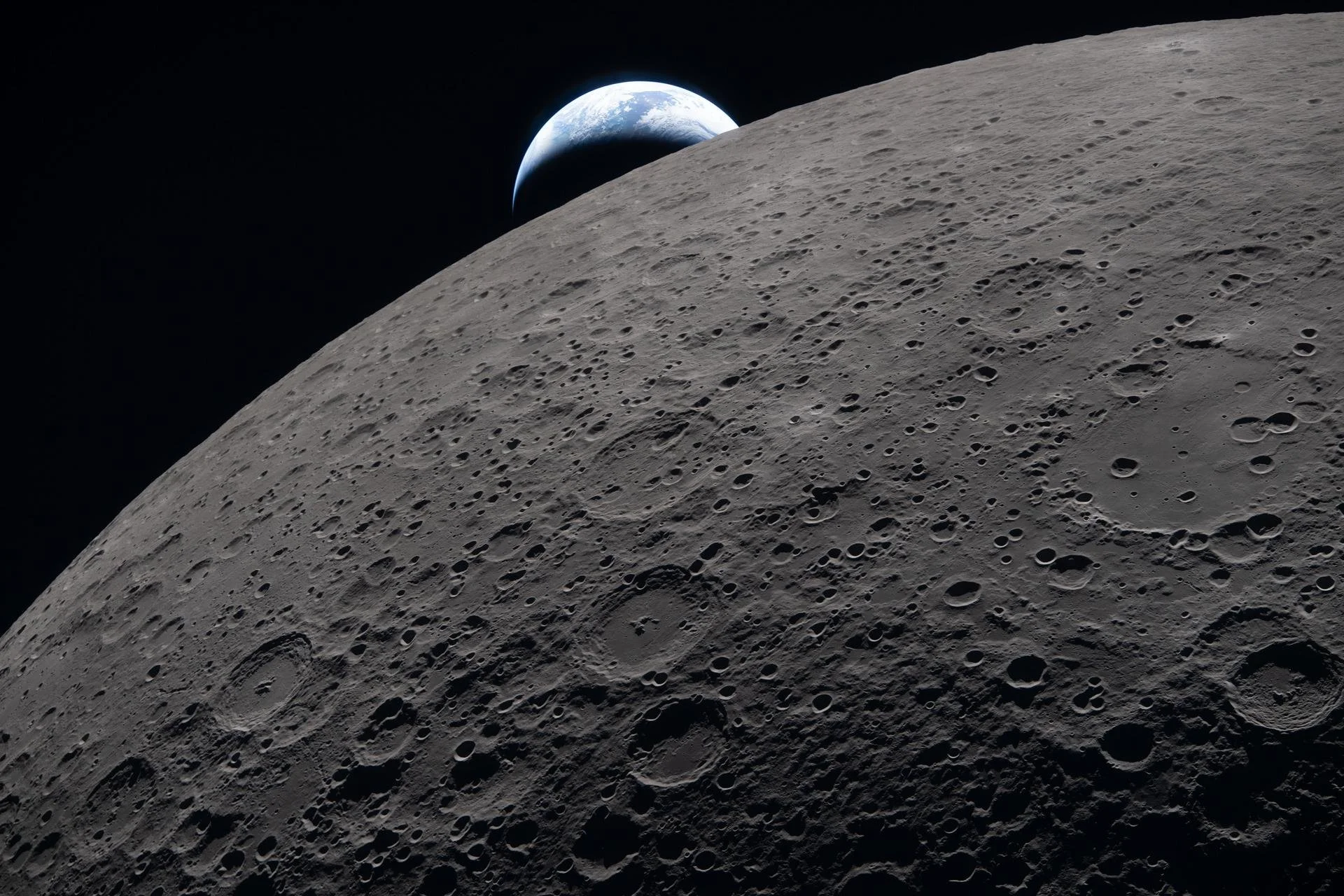
Image Credit: NASA/JCS
I’m following the Artemis II mission with our first astronauts in 50 years hurtling into space on top of an enormous Roman candle that has been slingshot around the moon and now on its way back to earth. How I wish Richard Wright were still alive so he could see the dark side of the moon! There’s been an entire generation who only knows of Space Shuttles and the International Space Station until now.
In modern society, we take our moon and sun for granted, but it wasn’t too far back in human history where there weren’t manmade calendars and devices used to set a standardized, chronological time. All we had was the sun, the moon, the stars, the planets, and even meteor showers that repeated themselves in predictable accuracy that allowed human minds to comprehend the passage of time. I had hoped in my lifetime I would have been able to fly high enough to see Earth’s curvature. Surely by now space travel would have become like Star Trek, although I fear we’ve become more like Battlestar Galactica, and I never made it on to the Concord.
Over the years in this blog I’ve gone on about the differently named moons and how they correspond to the seasons. But what is the moon to us today? Why are we investing so heavily in space while ignoring our own planet as it is increasingly crying out for mercy? If we think the moon and even Mars is going to be our escape hatch for a dying Earth, we’re woefully mistaken. I know, who am I but a farmer to go up against the greatest engineering minds out of Ivy League schools and international consortiums of astrogeology?
I am someone who has spent a lifetime learning what is required to sustain life not just in my immediate vicinity, but within an entire ecosystem. We have forgotten that what happens in our backyards impacts everyone on the planet, essentially the Butterfly Effect. This concept has been lost on many.
We joke about feeding our microbiomes each week at the market as we shop for living foods such as yogurts, cheeses, pickles, libations and just about anything else that will eventually pass through our digestive systems. News flash—those things don’t exist in a vacuum, i.e. Space. Farmers will be the first to tell you that life doesn’t exist without the microbes.
If we did somehow manage to make it on to the moon and beyond, how we would we reproduce? I was watching a hen lay an egg recently and realized how much gravity helps do the work. There’s an experiment for the Space Station. That got me thinking about how much more the continuation of life depends on gravity. Just think about human anatomy and reproduction; eggs move downward. When babies are born, much like an egg, they move toward the Earth. And what about plants? When pollination occurs pollen lands on the stigma, germinates and grows a tube downward to the ovary to fertilize what will become seeds. Plant roots grow in the direction of the statocytes on their root tips which are gravity-detecting sensors. Those same types of cells are also found in invertebrates that help to keep their balance. Life is so finely tuned to this planet if we only pay attention.
Now we’ve got elected officials legislating cow farts and tractor emissions when they are launching humans into space and going to war with each other. I will not speculate on how much the amount of fuel, particulate matter, greenhouse gases, and toxic materials trail after all the military endeavors alone polluting our planet. Hey but that’s OK, the Dow is over 50,000 right now. I think I will use that excuse the next time I get caught by one of those traffic cameras.
I have always loved the space program ever since as a child I watched Neil Armstrong step on to the moon. Space is fascinating and we can learn a lot about who we are, how we are created, and why it matters, but how are we to ever reach out to the stars if we continue to ignore what it takes to create and sustain life here on this planet?