
Pond Scum
This afternoon when I drove over to the local elevator to pick up minerals and salt, I got behind a pair of tractors, each pulling two grain carts, hooked together like a train, waiting to go through the scales and then on back for unloading. Most Americans have no concept as to what rural grain elevators do for their community, many believing them to only be abandoned silhouettes on the plains or the Midwest. But they play a vital role in the local agricultural communities as a place where small grains can be stored or sold. Elevators mix specific feeds using local grains and either provide them back to the farmer or sell them to the public.
Currently the locals are harvesting barley. The grain heads are collected using a combine, which is a big machine with a rotating harvester on the front and a hopper on the back. The remaining stalks are cut and baled, creating barley straw.
And at that moment, I knew how to fix the most frustrating issue facing America today.
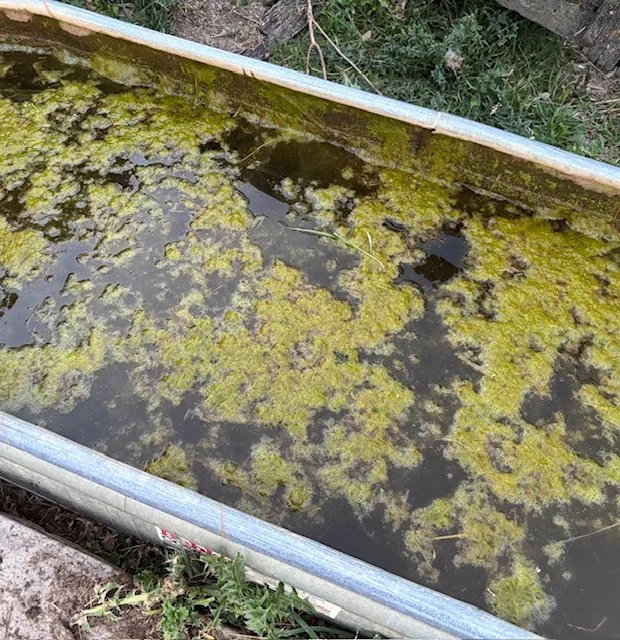
This is what happens when the country is run by career politicians, lawyers, and military officers, instead of farmers. They can’t fix the pond scum on the reflecting pool. Any farmer who has ever had a pond or even stock tanks have to perpetually manage their assorted single celled organisms as much as they do the products they cultivate. The simple remedy that works every darn time is barley straw. All the Park Service would need to do is float several bales of fresh barley straw in the reflecting pool and it would clear that algae infestation up in no time without chemicals and without damaging the paint job.
When you shop at the farmers market, you tend to think of farmers as the folks growing the food and the flowers, but every single one of us is a manager of our water features, be it a well, creek, spring, pond, riparian, irrigation, stock tanks, cisterns, etc. Our lives revolve around water one way or another. It’s always an ongoing battle to keep water clean and flowing. This is the time of year when we experience algae growth in anything that is shallow, warm, and still. Currently, I am battling algae in a bi-weekly basis in the stock tanks and there is no getting around it. I wait for the water level to go down low enough so I can easily tip the tank over, before standing it up on end to scrape out the long slimy strands of algae using a putty knife before rinsing the green goo and refilling the tank with freshwater. I tried putting barley straw in an oyster bag, but the livestock and dogs kept swiping it so I’m stuck with regularly scraping the tanks. In the pond, however, it is barley straw all the way.
The way people are using the word algae they make it sound as if it were a single entity— it is not. There are thousands of species of algae that are specific to their environment and the time of year. In the winter, the algae that grows on the stock tanks containing heating elements is entirely different than the algae that colonizes that same stock tank during the summer.
Go to any land grant University extension workshop on pond maintenance and they will explain that traditional mechanical methods and chemical control of algae is not always economical or efficient. I know that a few bales of straw aren’t as lucrative as a no bid contract, but that algae would be cleared up in a week if the job would have been given to a farmer instead of a felonious pool guy. The application rate for barley straw to control algae is two small bales per acre. Since the reflecting pool is approximately 7 acres, that would be 14 bales. I could fit that in the bed of a small pick-up truck, and they darn sure would not be as unsightly as a chain-link fence covered in tarps.