What Heat?
“Have you ever seen Young Frankenstein, the one with Marty Feldman and Gene Wilder?” I was asked last week at market. My response: “What hump?” as I stooped over, feigning a hunchback. Since then, I have felt like I am in a celluloid loop only this time asking, “What heat?” That is all that can be done as I run the gauntlet of late June early July farming.
Although extreme cold causes more injuries and deaths, extreme heat does it faster. When the weather apps tell me that triple digits over multiple days is barreling down the forecast, I need to break out my little packets of electrolytes to add to the water bottle.
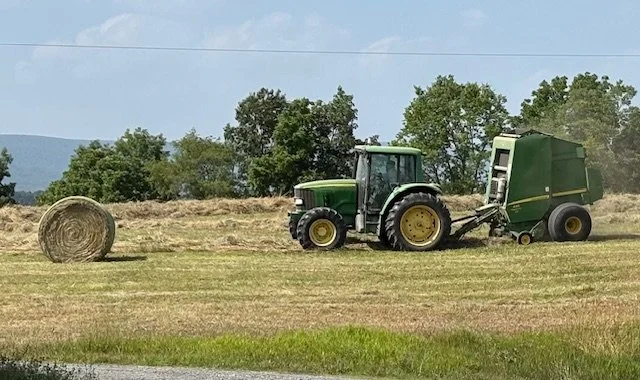
While it would be preferable to crank up the AC and retreat inside, farming is one of those occupations in which there is no choice, but to say what heat? My phone chirped with warnings from all the weather apps and the office of emergency services, only staying indoors was not an option because it was time to make hay. While it is the dairy farmers next-door who do the actual haymaking part with their huge tractors and assorted implements powered by hydraulics and a PTO, including a 16-foot mower, called a discbine, a rake, and a baling machine, which is a frightfully large and loud gadget that hoovers up the loose cut grass that has been raked into windrows and then spits out 900-pound round bales, I am still very much on deck, taking orders, answering questions, and delivering quart jars filled with ice water spiked with salt, lemon juice, and fresh fruit out to the field because in this heat, the AC in the tractor cab barely keeps up.
The heat is actually a blessing because it means that the cut grass will dry faster and more thoroughly. Given the price of diesel these days, having to make an extra pass on the cut grass with a tedder, another piece of machinery that fluffs up the cut hay so it will dry better, especially if a passing thunder shower occurs once it has been cut, is an unwanted expense. The key to successful farming is not what you sell, it is in what you do not spend in the producing of what you sell. If the tech bros really wanted to save the world, they would invent an electric tractor. Not just a cute one to zip around with on hobby farms, but large-scale equipment that can power the necessary implements required for food production, both livestock and produce. I would like to venture that it would be nice to have robotic hay making equipment that could function flawlessly in triple digit heat, but somehow I don’t think AI would be able to handle groundhog holes and an errant tomato cage that gets twisted up and spit out by the discbine. Someone has to go pick that up before it gets caught in the tines of the rake or worse, the baling machine.
The hay making this week is a race against time as heat domes usually precipitate thunderstorms and heavy rains, sometimes hail. You do not want to be in the middle of a large open field, sitting on top of a big piece of iron during an electrical storm. There have been a few times over the years where I have pushed the limits on the skid loader to get the last bales stacked in the barn as lightning crackles nearby. I will take the heat over lightning any day. And that is what I get this year. While my neighbors have the luxury of air-conditioned cabs on their tractors, the skid loader is an open station machine, which means spending several hours going back and forth between the fields and the hay barn without the benefit of air conditioning. Since the rain is not forecasted until Sunday night, I can take my time putting away the harvest, working in the cooler hours of the day. And this winter, when extreme temperatures swing the opposite direction into a polar vortex, I will change the question and ask what cold? in my best Marty Feldman voice, grateful for these hot days that provided the opportunity to make excellent hay.