
Thunder & Lightning
If you tried to pop into the Sunday Bethesda market in the final half hour last Sunday, you would have been woefully disappointed as many of the vendors packed up early and had vacated the parking lot by our normal closing time. You would’ve also gotten soaked and been at risk for being struck by lightning.
Sure, what are the chances of being actually hit by lightning?
According to the National Lightning Safety Council (NLSC) and the National Weather Service (NWS) your odds of being struck by lightning in any given year are about one in 1.2 million. However, the odds of being struck at some point in your lifetime are closer to one in 15,300. Those aren’t great odds, especially when you’re standing under a tent that is stretched over a metal framework on a wet surface out in the open.
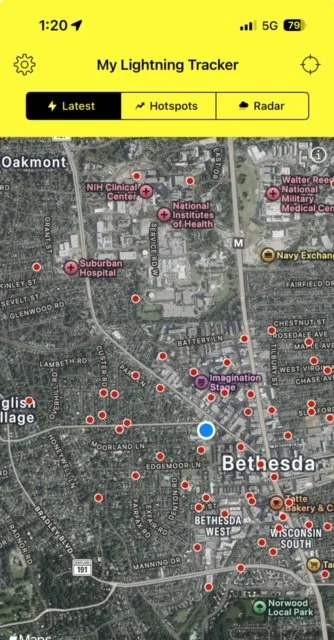
As someone who works outside regularly in the age of all things Internet, I have become mildly obsessed with weather apps, the latest one being My Lightning Tracker. It is a real time lightning monitor that can be granularly set to alert to strikes within a certain distance. Since I tend to follow the 30-30 rule which is when you see lightning count to 30; if you hear thunder before the 30 mark, the thunderstorm is close enough to be dangerous, my tracker is set to 30 miles for the start of alerts. The NWS storm data over the last 30 years cites the United States has averaged 43 reported lightning fatalities each year.
There was no denying a storm was on the way as the sky to the west turned ominously dark. Do you think it will hit us before the end of market became the question among vendors. So far this year we’ve lucked out with rain storms starting only after we had left the lot, but from the looks of the sky, Sunday was going to be a close call. My app started sending lightning alerts around 12:45 pm.
Some vendors pack up a little earlier than we should on days when there is inclement weather, but that’s a personal choice and more often it is due to the bitter cold than the oppressive heat. A late morning rain always turns the market into a lame duck, but a thunderstorm will bring business to a grinding halt. As soon as the lightning became visible, we rushed to dismantle our stands and pack up. Lightning flashed among the buildings as boxes, crates, coolers and tents were quickly stuffed into vehicles as the rain soaked everyone. By 1:30 the parking lot was nearly empty. We weren’t taking chances.
Being outdoors in the vicinity of a thunderstorm is dangerous even though 90% of people who are struck by lightning survive. There are multiple ways one can be injured by lightning including direct strikes, side strikes, splash contact injury, and ground current. Ground current occurs when lightning strikes nearby and travels through the ground. Side splash is more common when lightning strikes nearby and arcs to a body (this includes pets), and contact injury occurs when a person is touching an object that is struck.
In the event you are at the market when a thunderstorm rolls in, the safest thing to do is seek shelter immediately either inside a building or a vehicle. In the last few weeks, lightning strikes have damaged multiple homes throughout Maryland, sparking fires and displacing more than two dozen people although no one has been fatally struck this year. That does not mean they don’t happen. There have been four fatalities in Maryland, and four in DC since 2006.