
FUD In Our Food
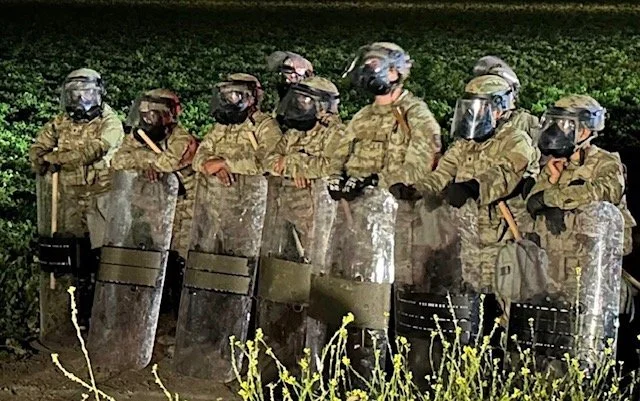
You can’t watch or listen to the national news, browse the podcasts or hit up social media sites without encountering the ICE raids currently taking place throughout the country. The monumental shows of force were sold to the public as a way to get rid of international miscreants like gang members and drug dealers. The coverage in California last week focused on cannabis growers in Carpenteria who took over the abandoned cut flower greenhouses when that industry left America for cheaper labor in Colombia and Ecuador who now dominate the global flower exports.
What few dared to publicize were the raids on the large fruit and vegetable growers on the Oxnard plain where massive fields of produce destined for large grocery store chains throughout the country are grown, a single field being the size of one of our market growers entire operation. While highly mechanized already, there are too many crops that depend on human hands, even if only those to operate the machinery.
Despite the trope of uneducated farm workers, the truth is agricultural laborers are highly skilled, often performing repetitive and difficult jobs that even the most able-bodied among us would find challenging, if not impossible. Heat waves and torrential rainstorms be damned, the crops must be harvested, packed, stacked, and transported before wilting and rotting. I’ve often joked that if most of the people in this country were tasked with raising their own food to survive, there would be a lot of skinny vegetarians.
Forget the knowledge and infrastructure and consider the sheer fortitude it takes to grow and harvest food. Snapping off a colander of green beans from the garden is idyllic, but how would you feel about doing that all day in the hot sun for a week before the field gets turned over into the next crop which may be peppers, or cauliflower, or celery, depending on the season and market demands.
Five years ago, in the throes of a global pandemic, immigrant agricultural workers were considered essential personnel keeping everyone forced to stay at home well fed. Go to work or you’ll lose your job workers in packing houses and processing plants were told. There was someone always willing to take their place, documented or not.
But the Fear, Uncertainty, and Doubt of being swept up in an ICE raid and sent to a prison in a war-torn country far exceeds that of a virus that could kill, and our essential workers aren’t showing up to work. Crops are rotting unharvested in the fields and orchards.
Back in April, I was discussing the loss of a quarter of their work force with a local food processor and received an eye-opening education on Operation Wetback and the Bracero Program. This week those two programs appeared in one of historian Heather Cox Richardson’s essays. The closest I came to being taught about these issues in school was reading Grapes of Wrath. Now I can see why Steinbeck’s classic routinely makes it on to banned book lists. Don’t teach about how badly migrant agricultural workers are treated, even if they are poor white Americans.
For the last twenty-five years I’ve straddled the line between urban and rural, living rural while conducting business in the city. There is such a huge disconnect between the two populations, my city folks asking how I can stand to live in such a {insert rural stereotype here} area while my neighbors routinely ask if I worry about my safety when I travel to the city each week with all those people, each side believing the other to be feared.
Our Fear, Uncertainty, and Doubt of the people who feed us is entirely unfounded. 85% of Americans polled want fairer and more just laws for immigrant workers and 79% believe that immigration is good for the country. I’m certain those numbers will rise even higher when prices rise in the grocery stores and restaurants who depend on large-scale agriculture to fill their shelves and plates.
We don’t need paramilitary goons harassing the hard-working people who produce our food. Their jobs are difficult as it is without having to worry about being terrorized in the tomato patch.
But how does all this affect the farmers markets? I’d be lying if I said all this FUD hasn’t been good for business, but it’s the why people are turning to local producers in lieu of their usual grocery stores that has given me pause. When I began growing for market over 20 years ago, customers were foodies, looking for the freshest, organic, artisan, heirloom, pasture-raised, sustainably sourced whatever; things you couldn’t find in a store. Everyone wanted to know their farmer as well as their food. The next wave of customers were people wanting clean food, those eschewing GMOs and proteins that hadn’t been produced using growth enhancements. But now, customers are looking for food security. They are asking questions not about farming methodologies, but about business continuity practices in the face of our new reality.